Well, sure. Here’s the code:
export function beforeRender(delta) {
  // ...

  // enable next/forward buttons
  debounceNext(delta)
  debouncePrev(delta)
}

export var analogInputs

var DEBOUNCE_TIME = 40;

var nextBtnState;
var nextBtnTimer;

function debounceNext(delta) {
  var newState = analogInputs[2] > 0.5;
  if (newState == nextBtnState) {
    nextBtnTimer = 0;
  } else {
    nextBtnTimer += delta;
  }
  if (nextBtnTimer > DEBOUNCE_TIME) {
    nextBtnState = newState;
    if (nextBtnState) {
      sequencerNext();
    }
  }
}

var prevBtnState;
var prevBtnTimer;

function debouncePrev(delta) {
  var newState = analogInputs[1] > 0.5;
  if (newState == prevBtnState) {
    prevBtnTimer = 0;
  } else {
    prevBtnTimer += delta;
  }
  if (prevBtnTimer > DEBOUNCE_TIME) {
    prevBtnState = newState;
    if (prevBtnState) {
      sequencerPrev();
    }
  }
}

export function sequencerPrev() {
  var p = playlistGetPosition() - 1;
  p = mod(p, playlistGetLength());
  playlistSetPosition(p);
}
(But note in the other thread I could clean up this duplication a bit by putting the state/timer/action variables in arrays.)
This is what the control box hardware looks like:
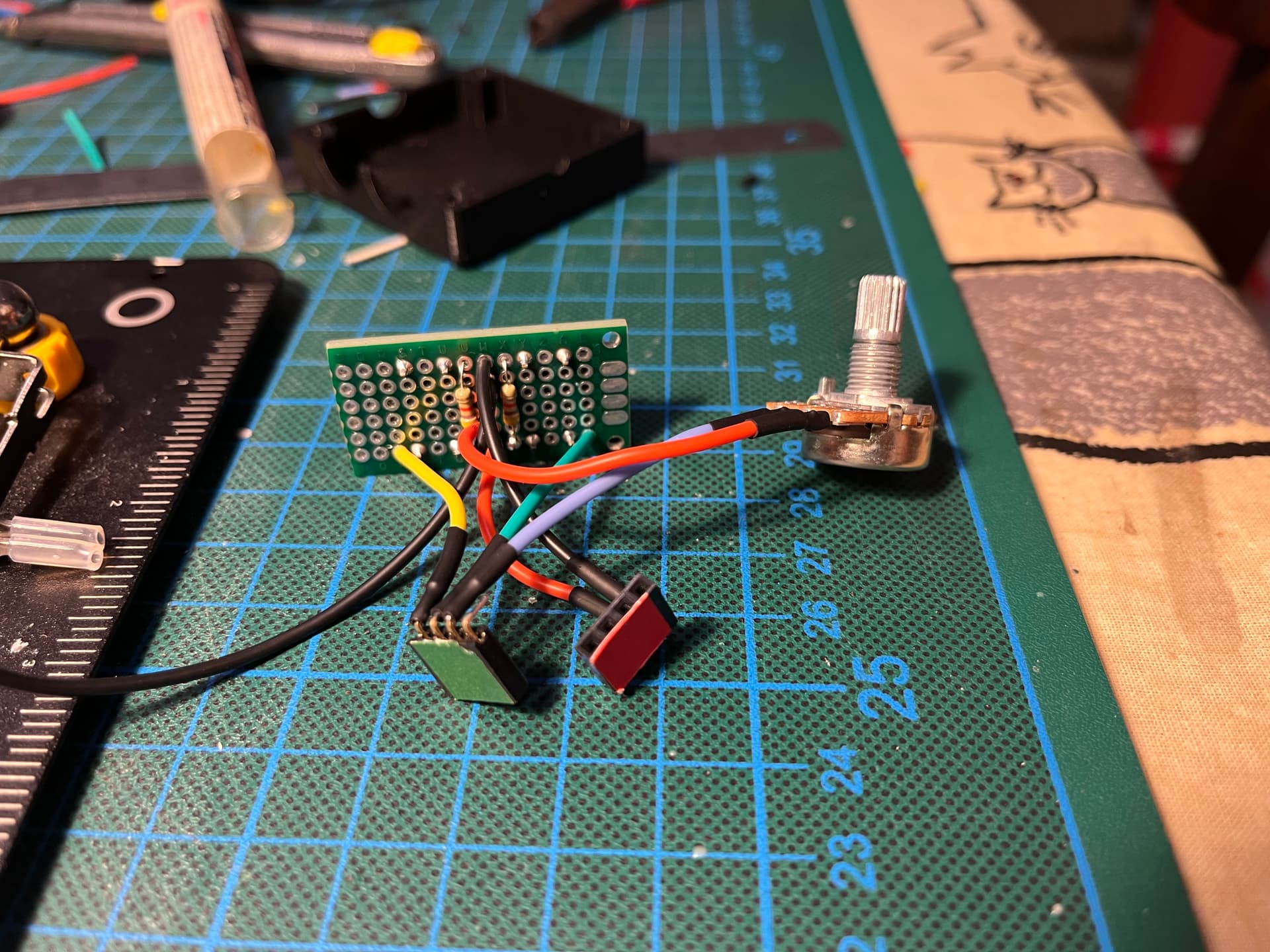
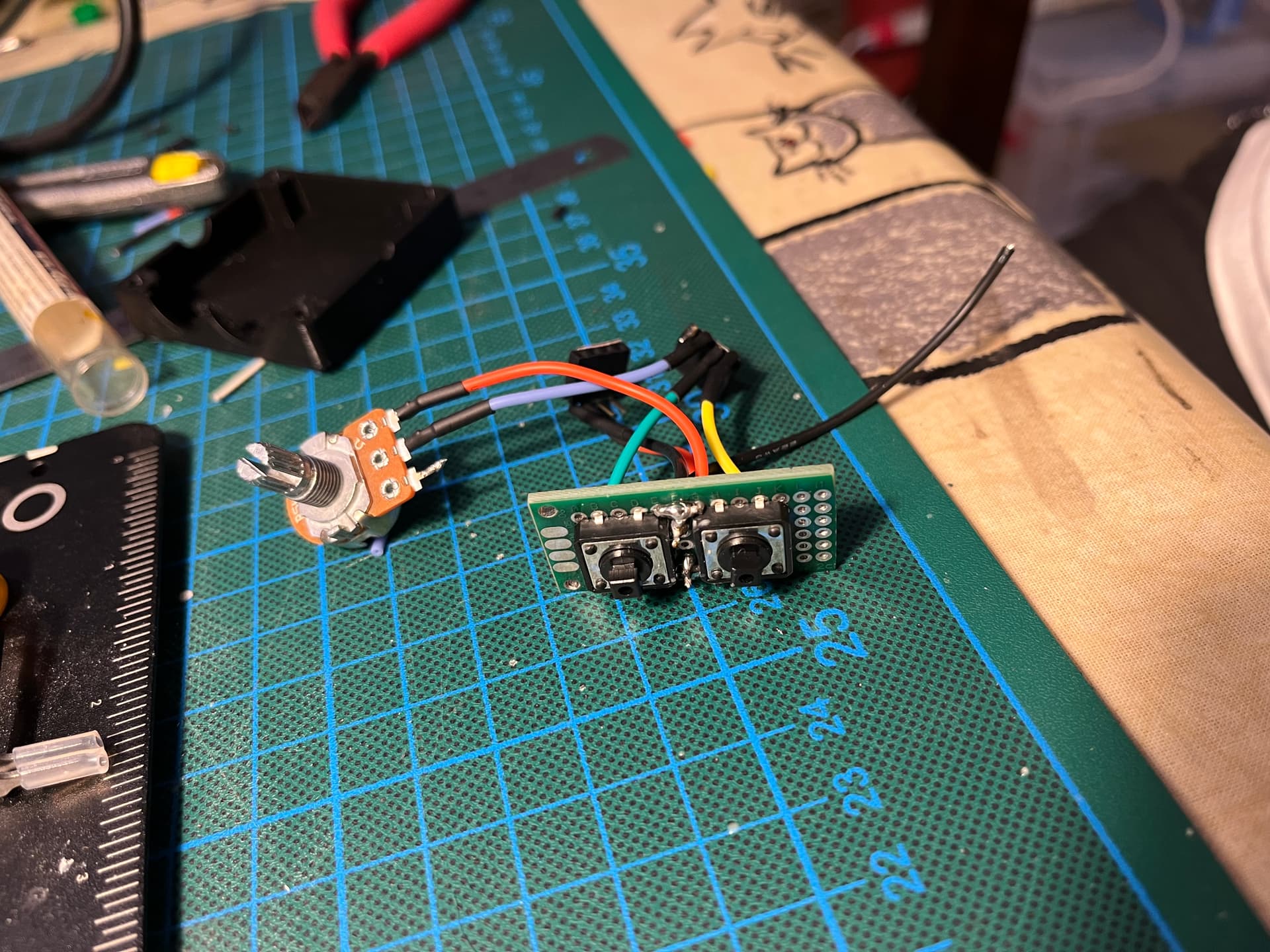
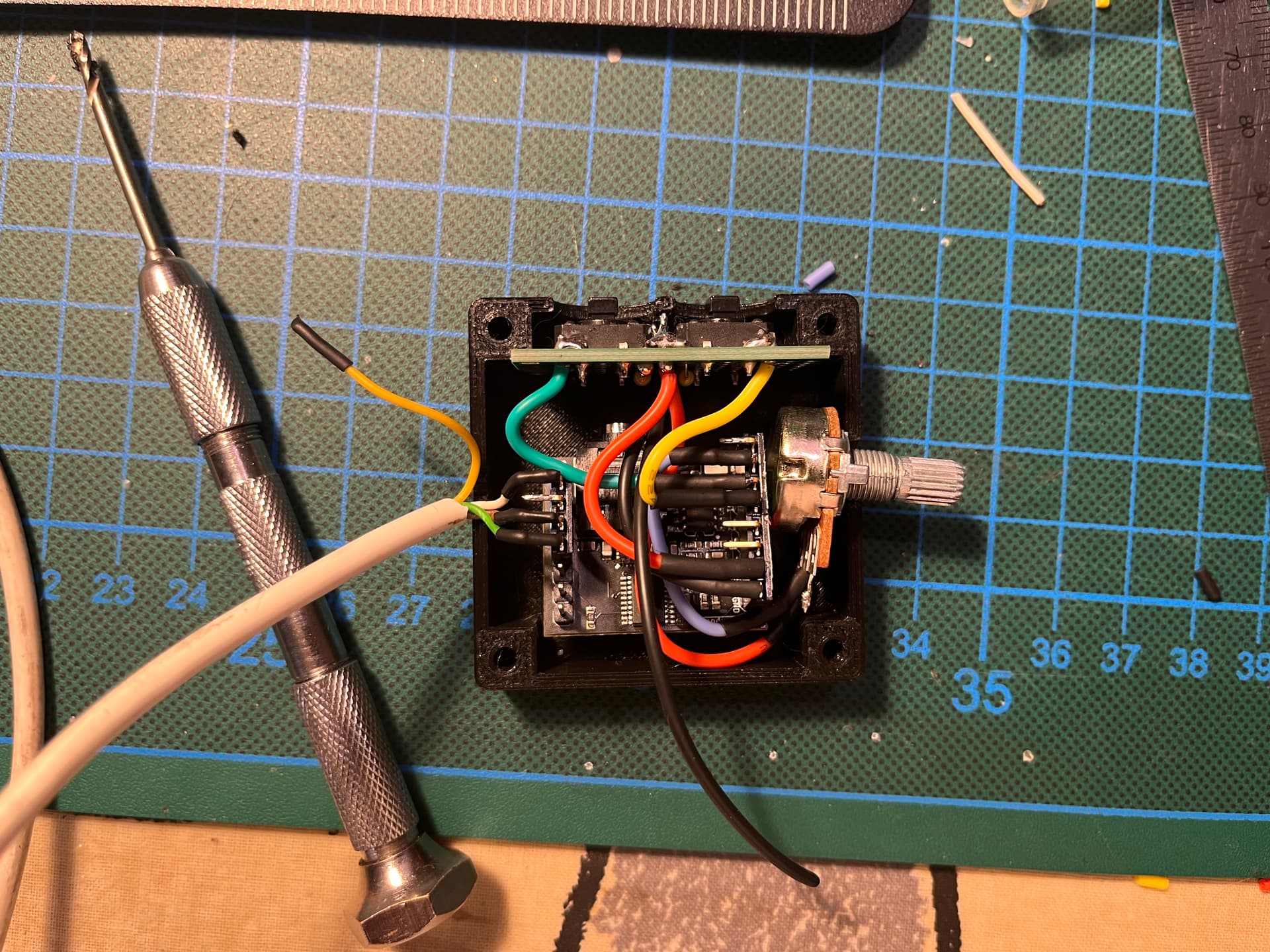
I’ve basically got a little board with the buttons mounted on it, plugged in to the analogue inputs of the sensor expansion board with a bodged-up connector made out of a right-angle header socket. The board has resistors that pull the button outputs down to ground (er, not in that picture though, that’s pre-fixing them to pull the correct pins down.) The pot is connected to another analogue input.
I read the button state and call the prev/next functions as per the code above and I’ve had to modify every pattern to multiply the brightness by analogInputs[0] (to which the pot’s wiper is connected.) Either rgb(r * analogInputs[0], g * analogInputs[0], b * analogInputs[0]); or hsv(h, s, v * analogInputs[0]).
And that’s about it! I’m planning on doing a bigger post on my blog about the build, but that’s going to have to wait until I’m back from the Burn :).